
Exciting News! We would like to announce that our office is now part of Foot & Ankle Clinics, P.A. We welcome back Dr. Carly Kriedberg to the Edina office starting November 2, 2020. Dr. Moeller continues to see patients one day a week as he continues inching toward retirement. We will be transitioning Dr. Moeller’s patients into Dr. Kriedberg’s schedule and appreciate your patience and understanding in facilitating this transition.
Click here for an important statement on the Coronavirus (COVID-19)Click here for info on the closure of our Chanhassen/Eden Prairie office
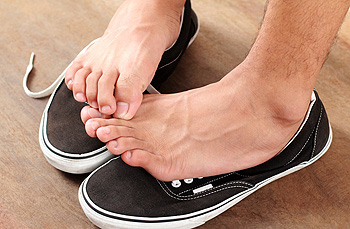
With over 125,000 sweat glands in the feet, it’s no wonder that everyone’s feet sweat occasionally. However, if you experience persistently slimy feet and struggle to keep them dry throughout the day, you may have plantar hyperhidrosis. This unpleasant and uncomfortable condition can also cause other embarrassing problems like foot odor and toenail fungus. You can try to manage plantar hyperhidrosis by washing your feet often, wearing cotton or moisture-absorbing socks, soaking your feet in black tea, applying anti-fungal powders or antiperspirant, and staying hydrated. If these home remedies don’t offer relief, you may consider contacting a podiatrist who can offer an array of medical treatments and procedures to help your condition.
If you are suffering from hyperhidrosis contact Roy Moeller, DPM of Foot & Ankle Physicians West. Our doctors can provide the care you need to attend to all of your foot and ankle needs.
Hyperhidrosis of the Feet
Hyperhidrosis is a rare disorder that can cause people to have excessive sweating of their feet. This can usually occur all on its own without rigorous activity involved. People who suffer from hyperhidrosis may also experience sweaty palms.
Although it is said that sweating is a healthy process meant to cool down the body temperature and to maintain a proper internal temperature, hyperhidrosis may prove to be a huge hindrance on a person’s everyday life.
Plantar hyperhidrosis is considered to be the main form of hyperhidrosis. Secondary hyperhidrosis can refer to sweating that occurs in areas other than the feet or hands and armpits. Often this may be a sign of it being related to another medical condition such as menopause, hyperthyroidism and even Parkinson’s disease.
In order to alleviate this condition, it is important to see your doctor so that they may prescribe the necessary medications so that you can begin to live a normal life again. If this is left untreated, it is said that it will persist throughout an individual’s life.
A last resort approach would be surgery, but it is best to speak with your doctor to find out what may be the best treatment for you.
If you have any questions please feel free to contact our office located in Edina, MN . We offer the newest diagnostic and treatment technologies for all your foot and ankle needs.
Read more about Hyperhidrosis of the Feet When the ligaments and tendons in the middle joint of toes slowly tighten up over time, the toes become forced to curl downwards. This results in what is known as hammertoe. Hammertoe can develop in any toe except the big toe. The joints will become stiffer over time and thus, harder to move without pain. Blisters and calluses may also begin to form on the toes. One of the most common causes of hammertoe is shoes that have narrow toe boxes, such as pointed toe high heels. Hammertoes can also be a result of a stubbed toe or toe fracture. Patients who are struggling with a painful hammertoe should consult with a podiatrist in order to get relief and treatment options.
Hammertoes can be a painful condition to live with. For more information, contact Roy Moeller, DPM of Foot & Ankle Physicians West. Our doctors will answer any of your foot- and ankle-related questions.
Hammertoe
Hammertoe is a foot deformity that occurs due to an imbalance in the muscles, tendons, or ligaments that normally hold the toe straight. It can be caused by the type of shoes you wear, your foot structure, trauma, and certain disease processes.
Symptoms
Risk Factors
Treatment
If you have hammertoe, you should change into a more comfortable shoe that provides enough room for your toes. Exercises such as picking up marbles may strengthen and stretch your toe muscles. Nevertheless, it is important to seek assistance from a podiatrist in order to determine the severity of your hammertoe and see which treatment option will work best for you.
If you have any questions, please feel free to contact our office located in Edina, MN . We offer the newest diagnostic and treatment technologies for all your foot care needs.
Read more about Hammertoe The tarsal tunnel is a narrow space located along the inside of the ankle, next to the ankle bones. This space contains many important structures, including the posterior tibial nerve. When this nerve is squeezed or compressed, it leads to symptoms that can affect the ankle and foot. These symptoms include numbness, tingling, burning, or electrical shock sensations, and shooting pain. Symptoms can appear suddenly or gradually over time, and tend to worsen with physical activity such as walking or prolonged standing. If you are experiencing the symptoms of tarsal tunnel syndrome, it is strongly suggested that you see a podiatrist for diagnosis and treatment.
Tarsal tunnel syndrome can be very uncomfortable to live with. If you are experiencing tarsal tunnel syndrome, contact Roy Moeller, DPM of Foot & Ankle Physicians West. Our doctors can provide the care you need to keep you pain-free and on your feet.
Tarsal Tunnel Syndrome
Tarsal tunnel syndrome, which can also be called tibial nerve dysfunction, is an uncommon condition of misfiring peripheral nerves in the foot. The tibial nerve is the peripheral nerve in the leg responsible for sensation and movement of the foot and calf muscles. In tarsal tunnel syndrome, the tibial nerve is damaged, causing problems with movement and feeling in the foot of the affected leg.
Common Cause of Tarsal Tunnel Syndrome
The Effects of Tarsal Tunnel Syndrome
A physical exam of the leg can help identify the presence of tarsal tunnel syndrome. Medical tests, such as a nerve biopsy, are also used to diagnose the condition. Patients may receive physical therapy and prescriptive medication. In extreme cases, some may require surgery.
If you have any questions please feel free to contact our office located in Edina, MN . We offer the newest diagnostic and treatment technologies for all your foot and ankle needs.
Read more about Tarsal Tunnel Syndrome Big toe pain is often characterized by discomfort while walking, tenderness, swelling, bruising, discoloration, misalignment of the toe, and bumps or other disfigurements of the feet. The big toe can hurt for a variety of reasons. Injuries, such as a fracture, sprain, bruise, or dislocation of the toe can occur when the toe is struck by an object or stubbed. Nerve damage to the toe can be caused by Morton’s neuroma, a thickening of the nerve tissue in the foot in response to injury, irritation, or compression. Inflammatory conditions such as gout or rheumatoid arthritis can lead to joint pain. Bunions are also a common source of pain and disfigurement of the big toe. If you have pain in your big toe, please see a podiatrist for a proper diagnosis and treatment.
Foot Pain
Foot pain can be extremely painful and debilitating. If you have a foot pain, consult with Roy Moeller, DPM from Foot & Ankle Physicians West. Our doctors will assess your condition and provide you with quality foot and ankle treatment.
Causes
Foot pain is a very broad condition that could be caused by one or more ailments. The most common include:
Diagnosis
To figure out the cause of foot pain, podiatrists utilize several different methods. This can range from simple visual inspections and sensation tests to X-rays and MRI scans. Prior medical history, family medical history, and any recent physical traumatic events will all be taken into consideration for a proper diagnosis.
Treatment
Treatment depends upon the cause of the foot pain. Whether it is resting, staying off the foot, or having surgery; podiatrists have a number of treatment options available for foot pain.
If you have any questions, please feel free to contact our office located in Edina, MN . We offer the newest diagnostic and treatment technologies for all your foot care needs.
Read more about Foot Pain
You don't need an excuse to have beautiful nails. Step outside without worrying about the appearance of your feet.
 A sprained or strained ankle is a common injury. While full recovery can take between 6 to 8 weeks, there are steps that you can take at home to encourage healing. Wrapping the ankle with a bandage can support it during short, necessary activities, like walking from room to room. Applying ice to the injured area can reduce pain and swelling. Resting the ankle is important to avoid aggravating the injury, and the ankle should be elevated while you rest. Taking nonsteroidal anti-inflammatory medications can also help reduce pain. For best results, it is important to follow the instructions of your doctor. If you have injured your ankle, it is recommended that you see a podiatrist for treatment.
Although ankle sprains are common, they aren’t always minor injuries. If you need your ankle injury looked at, contact Roy Moeller, DPM from Foot & Ankle Physicians West. Our doctors can provide the care you need to keep you pain-free and on your feet.
How Does an Ankle Sprain Occur?
Ankle sprains are the result of a tear in the ligaments within the ankle. These injuries may happen when you make a rapid shifting movement while your foot is planted. A less common way to sprain your ankle is when your ankle rolls inward while your foot turns outward.
What Are the Symptoms?
Preventing a Sprain
Treatment of a Sprain
In many cases, the RICE method (Rest, Ice, Compression, and Elevate) is used to treat ankle sprains. However, you should see a podiatrist to see which treatment option would work best with your injury. In severe cases, surgery may be required.
It is important to ask your doctor about rehab options after you receive treatment for your injury. Stretching, strength training, and balance exercises may help the ankle heal while also preventing further injury.
If you have any questions, please feel free to contact our office located in Edina, MN . We offer the newest diagnostic and treatment technologies for all your foot care needs.
Read more about Ankle Sprains Stubbing your toe into a piece of furniture or dropping a heavy object on it are common ways to get a toe broken. It is often immediately noticed, and symptoms can include bruising, swelling, and difficulty walking. Minor fractures are treated by using the buddy taping method, which is accomplished by taping the affected toe to the toe next to it. An X-ray is generally performed to determine the severity of the broken toe, and it often takes approximately six to eight weeks to heal. If the break is severe, the bone may need to be pushed back into place, or surgery may be necessary for proper healing. If you have broken your toe, please speak with a podiatrist as soon as possible.
A broken toe can be very painful and lead to complications if not properly fixed. If you have any concerns about your feet, contact Roy Moeller, DPM from Foot & Ankle Physicians West. Our doctors will treat your foot and ankle needs.
What to Know About a Broken Toe
Although most people try to avoid foot trauma such as banging, stubbing, or dropping heavy objects on their feet, the unfortunate fact is that it is a common occurrence. Given the fact that toes are positioned in front of the feet, they typically sustain the brunt of such trauma. When trauma occurs to a toe, the result can be a painful break (fracture).
Symptoms of a Broken Toe
Generally, it is best to stay off of the injured toe with the affected foot elevated.
Severe toe fractures may be treated with a splint, cast, and in some cases, minor surgery. Due to its position and the pressure it endures with daily activity, future complications can occur if the big toe is not properly treated.
If you have any questions please feel free to contact our office located in Edina, MN . We offer the newest diagnostic and treatment technologies for all your foot and ankle needs.
Read more about What to Know About a Broken Toe Stress fractures are tiny hairline fractures that are usually the result of the foot no longer being able to handle the loads and weight that are being placed on it. Issues such as overtraining or overuse, improper training, wearing improper footwear, foot deformities, and osteoporosis can all lead to stress fractures. Stress fractures are usually indicated by pain, swelling, redness, and bruising. If left untreated, they can lead to complete breaks. Patients who believe that they are suffering from a stress fracture should be under the care of a podiatrist to get a proper diagnosis and treatment. Treatment options include rest and immobilization, and in severe cases, surgery may be necessary.
Activities where too much pressure is put on the feet can cause stress fractures. To learn more, contact Roy Moeller, DPM from Foot & Ankle Physicians West. Our doctors can provide the care you need to keep your pain free and on your feet.
Dealing with Stress Fractures of the Foot and Ankle
Stress fractures occur in the foot and ankle when muscles in these areas weaken from too much or too little use. The feet and ankles then lose support when walking or running from the impact of the ground. Since there is no protection, the bones receive the full impact of each step. Stress on the feet can cause cracks to form in the bones, thus creating stress fractures.
What Are Stress Fractures?
Stress fractures occur frequently in individuals whose daily activities cause great impact on the feet and ankles. Stress factors are most common among:
Symptoms
Pain from the fractures occur in the area of the fractures and can be constant or intermittent. It will often cause sharp or dull pain with swelling and tenderness. Engaging in any kind of activity which involves high impact will aggravate pain.
If you have any questions please feel free to contact our office located in Edina, MN . We offer the newest diagnostic and treatment technologies for all your foot and ankle needs.
Read more about Stress Fractures of the Foot and Ankle
An ingrown toenail is defined as the nail on the big toe growing into the surrounding skin. Parents may notice their child is limping as this condition develops. In severe cases, it can cause difficulty walking, and may be beneficial to seek immediate treatment. Ingrown toenails can cause severe pain and discomfort, and often occur due to wearing shoes that do not have adequate room for the toes to move freely. Additionally, genetic factors may contribute to the onset of an ingrown toenail. The symptoms patients can experience can include redness, swelling, extreme tenderness, and a yellow discharge oozing from the affected area. If you notice your child has any of these symptoms, it is strongly suggested that you consult with a podiatrist who can effectively treat ingrown toenails.
Ingrown toenails may initially present themselves as a minor discomfort, but they may progress into an infection in the skin without proper treatment. For more information about ingrown toenails, contact Roy Moeller, DPM of Foot & Ankle Physicians West. Our doctors can provide the care you need to keep you pain-free and on your feet.
Ingrown Toenails
Ingrown toenails are caused when the corner or side of a toenail grows into the soft flesh surrounding it. They often result in redness, swelling, pain, and in some cases, infection. This condition typically affects the big toe and may recur if it is not treated properly.
Causes
You are more likely to develop an ingrown toenail if you are obese, have diabetes, arthritis, or have any fungal infection in your nails. Additionally, people who have foot or toe deformities are at a higher risk of developing an ingrown toenail.
Symptoms
Some symptoms of ingrown toenails are redness, swelling, and pain. In rare cases, there may be a yellowish drainage coming from the nail.
Treatment
Ignoring an ingrown toenail can have serious complications. Infections of the nail border can progress to a deeper soft-tissue infection, which can then turn into a bone infection. You should always speak with your podiatrist if you suspect you have an ingrown toenail, especially if you have diabetes or poor circulation.
If you have any questions, please feel free to contact our office located in Edina, MN . We offer the newest diagnostic and treatment technologies for all your foot care needs.
Read more about Ingrown Toenails
Do you suffer from heel pain when you get up in the morning? If so, you should seek the professional help of your podiatrist and have a proper diagnosis performed. Heel pain can be caused by several different foot-related conditions.